How It’s Made-how to make
- black garlic is ferment under high temperature and humidity
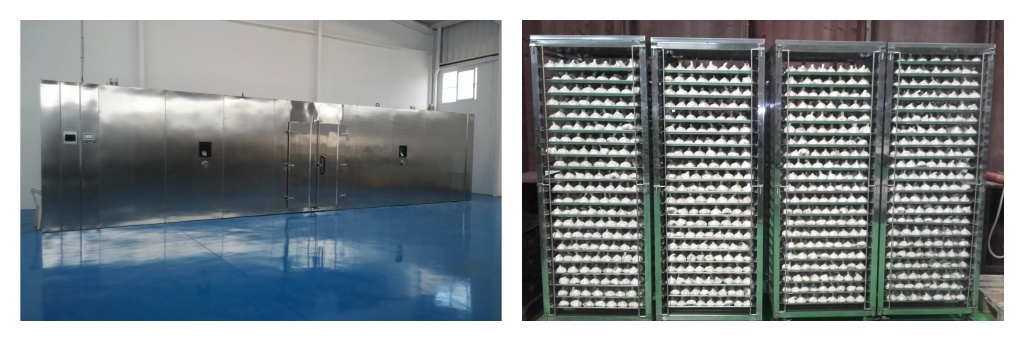
- 1. select fresh garlic, make sure no scar no broken,
- 2. load garlic on trays, 3.5kgs fresh garlic per tray, one layer garlic
- 3.load the trolley inside machine
- 4.set humidity 90%,temperature 65-75℃
- 5.15days later stop machine and pull all trolley out
1. Basic Principles of Fermentation
Black garlic fermentation is essentially an enzyme-driven reaction without microbial dominance. Under high temperature and humidity (60–85°C, humidity 70%–100%), the sugars and amino acids in garlic undergo the Maillard reaction, producing melanoidins (which give the black-brown color) and compounds like hydroxymethylfurfural. Meanwhile, allicin is converted into odorless active components (such as S-allyl cysteine). This process significantly increases antioxidant substances (like polyphenols and SOD enzymes) while reducing pungency and irritation.
2. Main Process Types and Procedures
2.1 Solid-State Fermentation (Traditional Process)
Applicable to: Whole garlic bulbs or single-clove garlic
Procedure:
- Pretreatment: Select fresh garlic (optimal diameter 2.8–3.2cm), soak in warm water for 20 hours to absorb water and soften.
- Fermentation: Place in fermentation chamber, control temperature at 60–65°C with 100% humidity, ferment for 20–30 days (divided into two phases: first 7 days for softening, remaining 13–23 days for blackening).
- Dehydration: Ventilate to reduce moisture content to 15%–45%, causing the garlic skin to separate.
Characteristics: Intact final product with soft, sticky texture, but time-consuming (>20 days).
2.2 Liquid Fermentation (Industrial High-Efficiency Process)
Applicable to: Garlic paste or crushed cloves
Procedure:
- Crushing: Garlic crushed to 4mm particle size.
- Mixing: Garlic paste mixed with water at mass ratio of 2:1.
- Staged Temperature Fermentation:
- Initial phase: 85°C for 5–6 days (accelerates Maillard reaction);
- Later phase: 70°C for 11–13 days (stabilizes color and flavor).
Characteristics: Time reduced to 16–19 days, polyphenol content increases 5-fold, SOD activity increases 15-fold.
2.3 Packaged Fermentation (Innovative Process)
Procedure: Garlic cloves/paste placed in heat-resistant food bags with 0%–5% garlic essential oil added, sealed and fermented at 50–80°C for 15–40 days, then vacuum-dried.
Advantages: No soaking or humidity control needed, prevents sulfide volatilization, antioxidant capacity reaches 135 g-Trolox/kg (20× increase from raw material).
2.4 Home Simplified Process (Rice Cooker Method)
Steps:
- Place garlic in rice cooker (with bamboo mat/kitchen paper), cover with wet towel;
- Keep warm mode (60–70°C) for 10–15 days, replace towel every 4–5 days.
Note: Best done outdoors to avoid lingering odor.
| Process Type | Raw Material Form | Temperature/Humidity | Time | Core Advantage |
|---|---|---|---|---|
| Solid-State Fermentation | Whole bulb/single-clove | 60–65°C, 100% humidity | 20–30 days | Intact product, soft texture |
| Liquid Fermentation | Garlic paste (4mm) | Staged temperature (85°C→70°C) | 16–19 days | High efficiency, significant active component increase |
| Packaged Fermentation | Cloves/paste | 50–80°C (no humidity control) | 15–40 days | No sulfur volatilization, simple operation |
| Home Rice Cooker | Whole garlic | 60–70°C (keep-warm mode) | 10–15 days | No special equipment needed |
3. Key Process Parameters Control
- Temperature:
- Staged temperature control is key: high-temperature phase (80–85°C) accelerates browning, low-temperature phase (55–70°C) stabilizes flavor.
- Above 90°C risks charring, below 50°C halts the reaction.
- Humidity:
- Solid-state fermentation requires near 100% humidity to prevent hardening.
- Liquid/packaged processes don’t need additional humidity control due to sealed environment.
- Time:
- Minimum 15 days for complete blackening, 30 days to reach peak flavor and active components.
- Raw Material Selection:
- Purple-skinned garlic with higher sulfur content generates more active substances, suitable for high-quality black garlic production.
4. Composition and Flavor Changes
- Active Component Increase:
- Polyphenol content increases 5-fold, total antioxidant capacity improves 10–20×;
- SOD enzyme activity increases 15-fold, enhancing free radical scavenging.
- Flavor Transformation:
- Pungent sulfides (diallyl disulfide) decrease, generating 2-ethyltetrahydrothiophene (mild aroma) and fructose derivatives (sweet-sour taste);
- Acids (acetic acid, succinic acid) increase, creating unique preserved fruit flavor.
5. Process Innovation and Optimization Directions
- Microbial-Assisted Fermentation: Adding Aspergillus niger promotes protein hydrolysis, shortening cycle and increasing S-propyl cysteine (flavor source) content.
- Composite Fermentation: Combining with Kombucha fermentation for 21 days increases total polyphenols to 185.97 mg GAE/g, boosting antioxidant activity by 68.34%.
- Energy Optimization: Non-fermentation methods (high-temperature/pressure steaming) reduce energy consumption but with lower active component retention.
6. Summary
The core of black garlic fermentation lies in temperature and humidity control to trigger the Maillard reaction, achieving de-pungency and functional enhancement. Solid-state fermentation suits whole garlic production, liquid fermentation improves efficiency, packaged technology simplifies the process, while home methods lower the technical threshold. Future directions focus on microbial applications, refined staged temperature control, and composite fermentation development to balance active components, flavor, and cost.